We Rebuilt Our 12-Year-Old iOS Game. Here's What We Learned
In May 2014 I shipped a small iPhone game called Touch The Colorful Tile. It was written in Objective-C on Apple's SpriteKit framework. You tapped colored tiles as they scrolled past, and the game sped up until you missed. Honestly, it was a pretty basic game. I built it as a learning experience, and as a cheap way to test a market I didn't know yet. Then, like a lot of apps from that era, it sat mostly untouched while the iPhone moved on without it.
This week, twelve years later, version 2.0 went live as [Colorful Tiles: Rhythm Run](https://colorful-tiles.vercel.app/). It isn't a patch. I rebuilt the game from the ground up, and it's out now on the App Store and Google Play.
This post covers why I came back to it, what changed, and why I rebuilt it instead of updating it. If you own an older app of your own, the reasoning applies well beyond games.
Why now: Apple was about to remove it
The push came from Apple. The App Store removes apps that haven't been updated in years, and Touch The Colorful Tile was on that list. I had two options. I could let a twelve-year-old app quietly disappear, or I could finally do something with it.
The timing worked out. I had some free time, and I wanted a real project for experimenting with AI tools, especially for generating game assets. A small game with a simple core loop was the right size to try that end to end.
What Colorful Tiles is now
The core idea survived: tap the tile at the right moment. Everything around it is new.
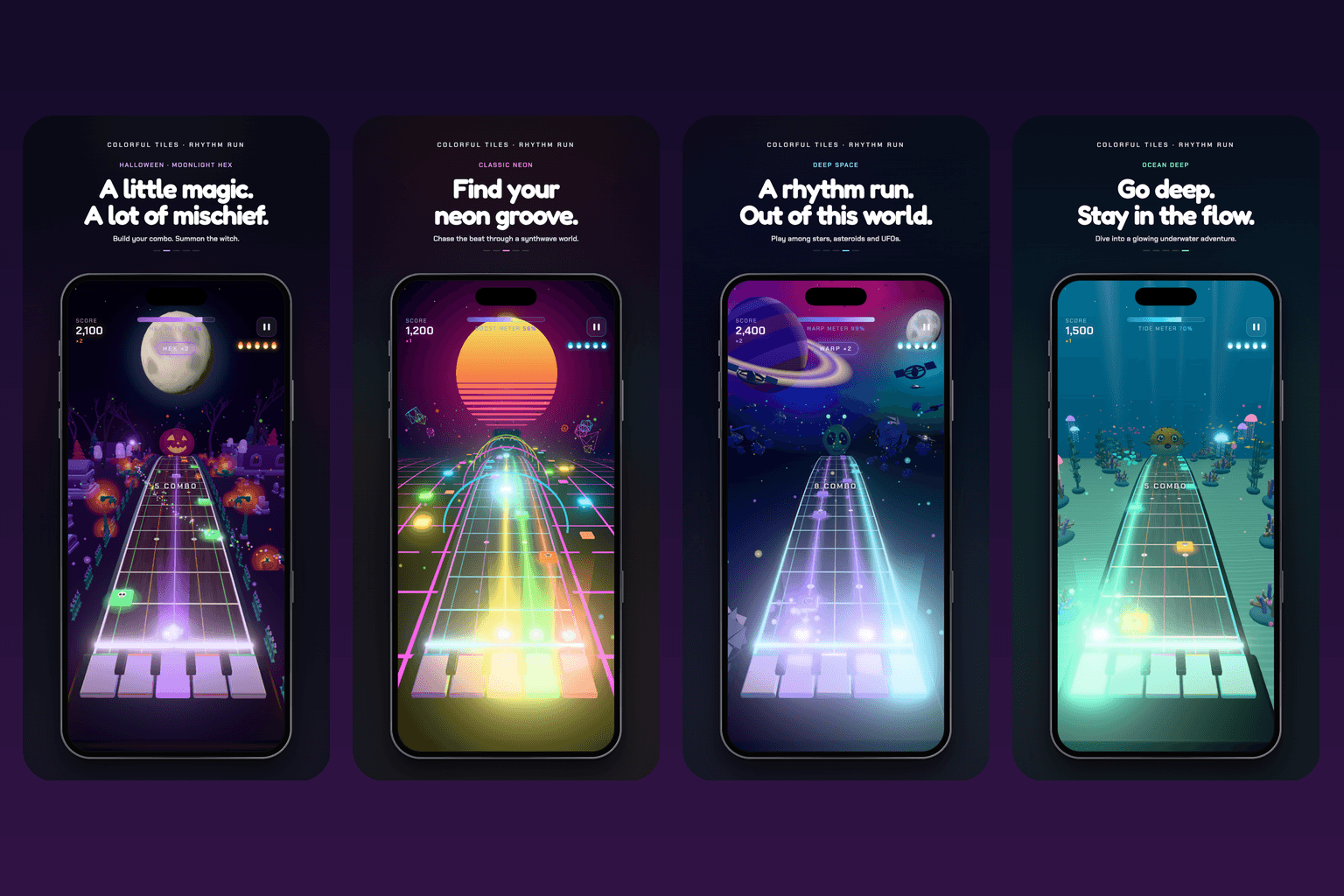
A 3D rhythm game instead of a 2D tapper. Tiles travel down a glowing fretboard that curves off into the distance. You tap a lane as its tile crosses the line, Perfect hits build your combo and multiplier, and every round gets a little faster.
Themed worlds. Each theme has its own scenery, its own songs and its own mascot. Fill the theme's meter and the mascot shows up with double points and a life back.
Halloween, live all October: a moonlit graveyard with gems sliding past gravestones and carved pumpkins, and a witch who swoops in on her broom.
Classic Neon: a retro synthwave track under a setting sun, with a comet.
Deep Space: a fretboard floating through asteroids, with a UFO.
Ocean Deep: a coral reef with fish, jellyfish and a manta ray.
Winter Wonderland arrives in December.
Seasonal by default. Set the theme to Auto and the game changes with the calendar, so a returning player finds something new without downloading an update.
Twelve classic melodies. These include Grieg's In the Hall of the Mountain King, Bach's Toccata and Fugue, Beethoven's Ode to Joy and Für Elise, Mozart, The Blue Danube, and sea shanties for the reef.
Fair difficulty. Easy, Normal and Hard are tuned so that every song runs at the same pace, and no track is secretly harder than the rest.
Share cards. When you finish a run you can share a score card, and sharing earns bonus lives.
Why I rebuilt instead of updating
A twelve-year-old app is written for a phone that no longer exists. In 2014 the newest iPhone was the 5s, screens were small and the same size from model to model, and most mobile games were flat 2D. Since then iOS and the hardware have changed beyond recognition. Screen shapes changed, notches and Dynamic Island arrived, and players now expect smooth 3D, haptics and sharing as standard.
The original code made the decision even clearer. SpriteKit is a 2D framework and runs only on Apple platforms, and Objective-C has given way to Swift in Apple's own tooling. The game I wanted was a 3D game that also runs on Android, and the old codebase couldn't get there by patching.
It's still worth going through the choice every owner of an older app faces: patch it or rebuild it?
Signs a patch would have been enough
The app's core still matches what users want today.
The code still builds with current tools after modest fixes.
The changes you need are cosmetic or limited to one area.
Signs a rebuild is the honest answer
The product idea itself has to change. A flat tapper and a 3D rhythm game share a mechanic, but the rendering, timing and progression are completely different systems.
The platform underneath has moved on. When the framework or language your app depends on can't support where you want to go, every patch is a detour.
You want things the old design never planned for, such as seasonal content, multiple themes, sharing, or a second platform.
Colorful Tiles hit all three. I kept the name, the App Store listing and the heart of the gameplay, which is the part players remembered. Everything else I rewrote.
Using AI tools for game assets
In 2014 the art was the bottleneck. A solo developer either learned to draw, paid an artist, or settled for simple shapes, and the original game mostly settled. This time I used AI tools to generate game assets, and that changed what one person could realistically ship. Four fully themed worlds, each with its own scenery and mascot, would have been out of reach for a side project back then.
What I took away from it:
AI makes the first draft cheap, not the final product. Generating options is fast. Choosing, adjusting and making assets work together in one consistent style is still design work.
Consistency is the hard part. One good image is easy. Forty assets that look like they belong in the same world takes a clear style direction and a lot of curation.
It moves the bottleneck. With art no longer the slowest step, the real work goes back to gameplay feel, timing and polish, which is where it should be.
What we'd tell anyone with an old app
Keep the listing and the identity. I updated the existing App Store entry instead of launching a new app. That keeps the app's history, its reviews and anyone who still has it installed.
Rebuild around the one thing people loved. Ours was "tap the tile at the right moment." Write that sentence down for your product before you touch any code. If a new feature doesn't serve it, it waits.
Design for content, not just features. Themes, songs and seasonal events can be added without rewriting the game. That turns one launch into a reason for players to come back every few months.
Ship to both stores together. The same rebuild now runs on iOS and Android, which roughly doubles the audience for the same core work. Our cross-platform apps page covers when that approach makes sense.
Treat a removal notice as a decision point. A warning from Apple or Google is a natural moment to decide whether an old product deserves a rebuild or a graceful retirement. Either answer is fine. Drifting until it disappears isn't.
Give the product a home on the web. The game now has its own site with store links, support and privacy pages, so players who share their score cards have somewhere to send their friends.
The same thinking applies to business software. A stalled app or an aging codebase usually needs one honest decision about whether to fix it or rebuild it before anyone writes code. Our software project rescue playbook walks through how we make that call.
Play it
Colorful Tiles: Rhythm Run is free on the App Store and Google Play, and it needs iOS 15 or later on iPhone. October is the perfect time to start, while the Halloween graveyard is live. Winter Wonderland follows in December.
Colorful Tiles is also the first of a few older games I'm bringing back the same way, so expect more of these stories here.
If you have an older app of your own, whether it's a game or a business product, and you're not sure whether to update it or rebuild it, that's exactly the kind of decision we help with. We build both mobile games and iOS apps. Book a free discovery call, and we'll give you a straight answer about which path makes sense.