How to Build a Scalable SaaS MVP on AWS (2026 Guide)
Most SaaS MVPs fail for a simple reason.
They are either overbuilt from day one, or they are so fragile that they break the moment real users show up.
Neither approach works.
A good MVP is something you can build quickly, launch fast, and still trust when usage starts growing. If you are using AWS, you already have everything you need to do this right without turning your system into a mess.
This is how I approach it.
What “Scalable MVP” Actually Means
When people hear scalable, they think about massive systems and millions of users.
That is not what matters at this stage.
A scalable MVP simply means you can go from zero to a meaningful number of users without rewriting your backend or rethinking your entire architecture. It means your core decisions hold up when real usage starts.
If you can reach that point, you are ahead of most teams.
The Trap Most Teams Fall Into
Early on, there is a strong temptation to build things the “right” way.
That usually leads to multiple services, complex infrastructure, and a lot of time spent thinking instead of shipping.
In reality, complexity is your biggest risk. It slows development, introduces more failure points, and makes it harder to iterate.
That is why I start simple.
One backend service. One database. Clear API boundaries.
You can evolve from there when the product proves itself.
A Practical AWS Setup That Actually Works
A solid MVP architecture on AWS is not complicated.
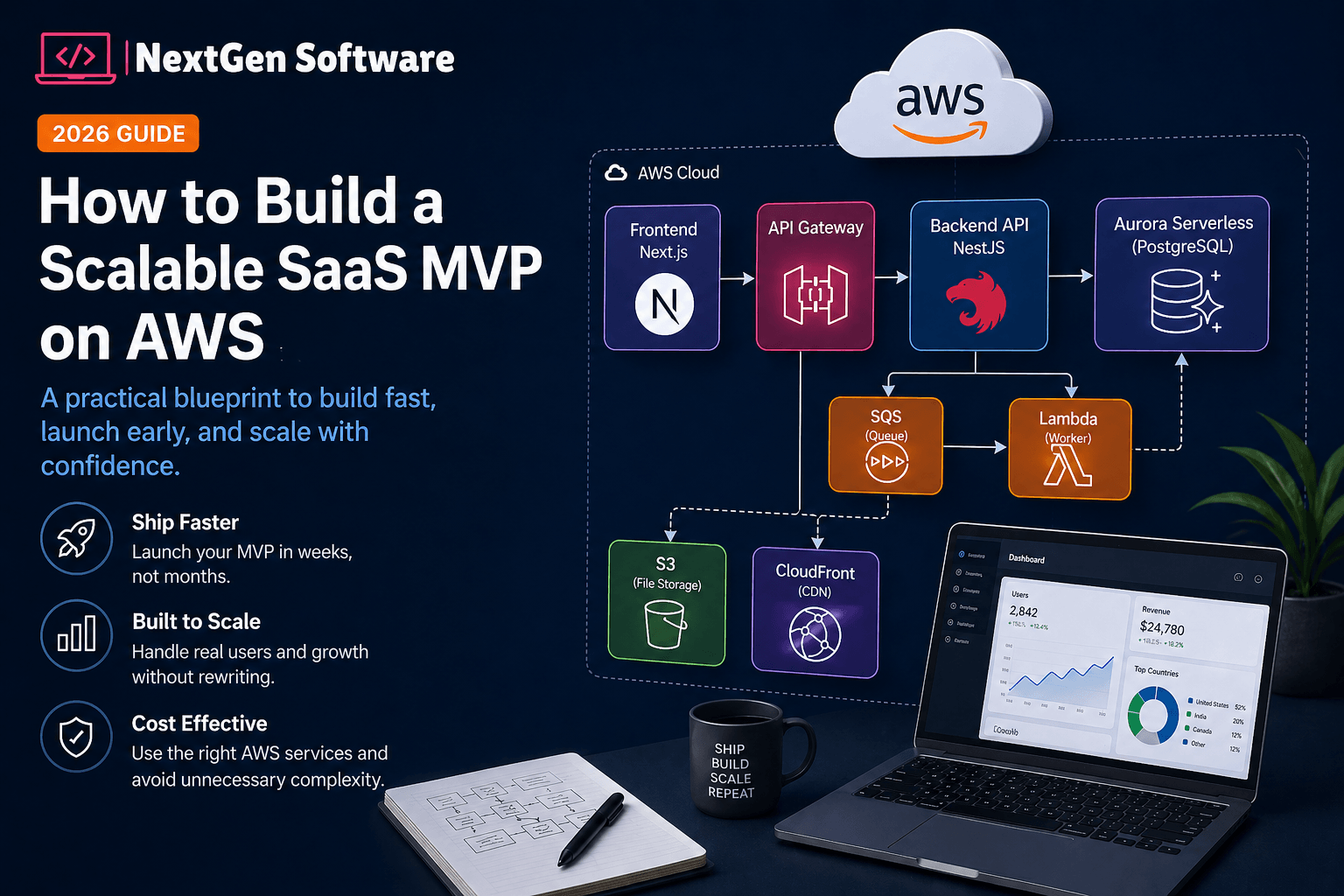
Your frontend, typically built with Next.js, handles the user experience. It communicates with a backend API, often built with NestJS, where your business logic lives.
On AWS, the setup usually looks like this:
API Gateway handles incoming requests. Your backend runs on Lambda for simpler workloads or ECS when you need more control. Your data lives in a PostgreSQL database using Aurora Serverless. Files are stored in S3 and delivered through CloudFront. Any heavier work gets pushed into a queue with SQS and processed in the background.
That is your foundation. It is simple, reliable, and easy to extend.
Your Database Decision Is Critical
If there is one decision that is painful to change later, it is your database.
For most SaaS MVPs, PostgreSQL is the right starting point. Aurora Serverless makes it even easier by handling scaling for you while keeping costs reasonable early on.
This becomes especially important if your product involves payments, subscriptions, wallets, or anything transactional. You want strong consistency and predictable behavior.
What About DynamoDB?
DynamoDB is powerful, but it is often misunderstood.
It works best when you have very clear and stable access patterns. High-volume event data, simple key-value lookups, activity feeds, notifications, and logging are all great fits.
Where teams run into trouble is trying to use DynamoDB as their primary database too early. MVPs change constantly. You will need flexible queries, joins, reporting, and the ability to answer new questions quickly. That is where a relational database like PostgreSQL shines.
A better approach for many products is hybrid.
Use PostgreSQL as your system of record for core data like users, billing, permissions, and transactions. Introduce DynamoDB later for specific workloads that benefit from its performance and scale.
The mistake is not using DynamoDB. The mistake is choosing it before your product actually needs it.
Handle Slow Operations the Right Way
One of the fastest ways to degrade your app is by letting slow operations block your API.
Sending emails, processing files, generating reports, or making AI calls can take time. If you handle them during the request, your app will feel slow and unreliable.
A better approach is to move that work into the background.
Using SQS, you can queue these tasks and process them asynchronously. Your API stays fast, and your system becomes much more resilient.
You Probably Do Not Need Real Time Yet
Real time features are often overestimated early on.
Polling is usually enough. Checking for updates every few seconds is simple, reliable, and easy to maintain.
If your product truly depends on real time interactions, then it makes sense to introduce WebSockets. Otherwise, it is something you can layer in later.
Use S3 for File Storage From Day One
Files should not live in your backend.
S3 is built for this. Whether it is uploads, exports, or generated documents, store them there and serve them through CloudFront.
It improves performance and simplifies your system.
Keep Authentication Simple
Authentication is not where you should be spending your time.
AWS Cognito is a solid managed option if you want to stay fully within AWS. Tools like Clerk can get you moving faster if developer experience is the priority.
The key is not to build your own auth system.
Think About Cost Early
Infrastructure cost becomes a problem when it is ignored.
A well-designed AWS MVP can stay relatively low cost by using serverless components, auto-scaling databases, and caching where it actually matters.
Most cost issues come from unnecessary complexity, not from AWS itself.
What You End Up With
If you keep things simple and make a few key decisions correctly, you end up with a system that can be built quickly, supports real users, and scales without forcing a rewrite.
That is the goal of an MVP.
Not perfection. Just something that works and keeps working.
Final Thought
AWS is not the difficult part.
The difficult part is resisting the urge to overbuild.
If you stay focused, keep your architecture simple, and make intentional decisions around your database and async processing, you will move faster and avoid the problems that slow most teams down.
Need Help Building Your MVP?
At NextGen Software, we build SaaS platforms that are designed to ship quickly and scale cleanly.
If you are trying to go from idea to production without wasting months, reach out.