Agentic AI vs Traditional Automation: When to Use Which
The Automation Landscape Has Changed
A few years ago, automation meant one thing: a rule-based system that followed a fixed script. Set a trigger, define a response, repeat forever. That model still works well in many situations. But today, a new category has emerged called agentic AI, and it is reshaping what businesses expect software to do.
If you are a business owner or startup founder trying to figure out how to reduce manual work, improve efficiency, or build smarter products, you have probably run into both terms. They are not interchangeable. Choosing the wrong approach can mean wasted budget, frustrated users, or a system that simply does not deliver.
This guide breaks down exactly what each option is, where each one shines, and how to decide which one belongs in your next project.
What Is Traditional Automation?
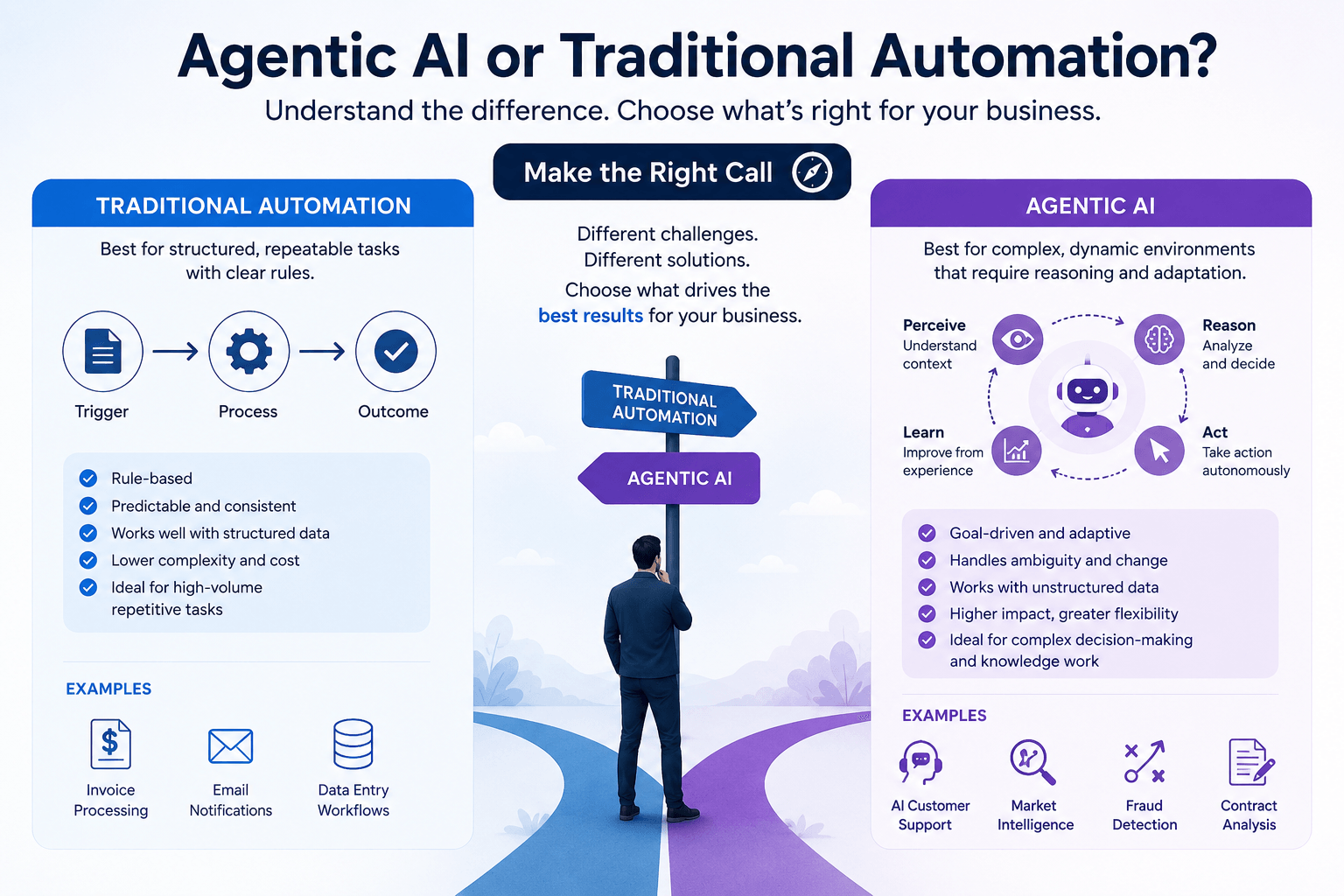
Traditional automation refers to systems that follow predefined logic to complete repetitive tasks without human intervention. Think of it as a very reliable, very literal employee who does exactly what you tell them, nothing more.
Common examples include:
Sending a welcome email when a user signs up
Syncing customer data between a CRM and an invoicing tool
Generating weekly reports from a database
Routing support tickets based on keywords
These workflows are built with tools like Zapier, Make, or custom-coded scripts, and they excel when the input is predictable and the expected output is well-defined.
The Strengths of Traditional Automation
Reliability: It does the same thing every time, with no surprises.
Speed to build: Simple workflows can be set up in hours, not weeks.
Cost efficiency: Lower upfront investment for straightforward tasks.
Auditability: Every step is traceable, which matters for compliance-sensitive industries.
The Limitations
The moment conditions become unpredictable, traditional automation breaks down. It cannot handle ambiguity, make judgment calls, or adapt to new information mid-task. If an edge case arises that was not accounted for in the original logic, the system either fails silently or throws an error.
What Is Agentic AI?
Agentic AI refers to AI systems that can plan, reason, and take multi-step actions to achieve a goal, often with minimal human supervision. Rather than following a fixed script, an agentic AI model interprets an objective and figures out how to accomplish it, adjusting as new information comes in.
Practical examples include:
An AI agent that researches competitors, summarizes findings, and drafts a report, all from a single prompt
A customer service agent that reads an email, checks order history, initiates a refund, and sends a personalized reply
A sales agent that qualifies leads, books meetings, and updates a CRM based on conversation outcomes
A development assistant that writes code, runs tests, identifies bugs, and proposes fixes
Agentic AI systems typically combine a large language model (LLM) with the ability to use tools, access data sources, and execute actions across multiple steps.
The Strengths of Agentic AI
Flexibility: It handles situations that were never explicitly programmed.
Complex reasoning: It can weigh tradeoffs and make context-aware decisions.
End-to-end task completion: One agent can do what previously required a chain of separate automations.
Scalability of cognition: It handles knowledge-intensive work that no simple rule set can capture.
The Limitations
Agentic AI is not perfect. It can occasionally produce unexpected outputs, requires careful guardrails, and takes more thoughtful architecture to deploy safely. It is also more resource-intensive, meaning higher ongoing compute costs compared to a basic automation script.
Side-by-Side Comparison
Factor | Traditional Automation | Agentic AI |
|---|---|---|
Task type | Repetitive, rule-based | Complex, context-dependent |
Decision-making | None, follows rules | Yes, reasons through options |
Handles edge cases | Rarely | Often |
Setup time | Fast | Longer, more design needed |
Cost to run | Low | Moderate to high |
Best for | Predictable workflows | Dynamic, multi-step goals |
How to Decide Which One Your Business Needs
The right choice depends on what problem you are actually trying to solve. Here is a practical framework:
Choose Traditional Automation When:
The process is highly repetitive and follows a consistent pattern every time.
Inputs and outputs are well-defined, such as syncing data between two platforms.
Speed and low cost matter more than flexibility.
You need airtight reliability with full auditability, such as in financial or legal workflows.
If you are connecting your e-commerce store to your fulfillment system, or auto-tagging contacts in your CRM based on form responses, traditional automation is the right tool. It is mature, dependable, and cost-effective for these use cases.
Choose Agentic AI When:
The task requires interpretation, such as reading an unstructured email and deciding what to do next.
Workflows change based on context, meaning the right next step depends on what was discovered in a previous step.
You want to automate knowledge work, not just data movement.
You are building a product feature that needs to feel intelligent and responsive to users.
If you want to build an AI-powered onboarding assistant, an autonomous research tool, or a support agent that actually resolves issues rather than just routing them, agentic AI is the right foundation.
Consider Using Both Together
Many of the best systems combine both approaches. A traditional automation might handle the reliable, routine backbone of a workflow, while an agentic AI component handles the steps that require judgment. For example, a billing system might use standard automation to generate invoices, but route disputed invoices to an AI agent that analyzes the account history and drafts a resolution response.
Common Mistakes to Avoid
Over-engineering simple tasks. Not every automation needs AI. If a rule covers 99% of your cases, use a rule.
Under-investing in agentic systems. Giving an AI agent the wrong tools or too little context leads to poor results, not AI-specific results.
Skipping the architecture conversation. Whether you are building with traditional automation or agentic AI, the design decisions made upfront determine whether the system scales or becomes a maintenance nightmare.
Ignoring oversight and guardrails. Agentic AI systems should have defined boundaries, logging, and human review mechanisms, especially when they take actions with real-world consequences.
The Bottom Line
Traditional automation and agentic AI are both powerful, and the best-built software products today use each one where it fits best. The key is understanding your actual problem before choosing a tool. If your workflow is predictable, automate it simply. If it requires reasoning and adaptability, bring in agentic AI.
At NextGen Software in Boca Raton, FL, we help startups and growing businesses design and build custom software that uses the right technology for the right job, whether that means clean API integrations, AI-powered automation, or full agentic systems built around your specific workflows. If you are not sure which direction makes sense for your business, the best next step is a conversation. Visit nextgensoftware.us to schedule a free discovery call and get a clear picture of what is possible.