Custom Software Development Cost Per Hour: 2026 Rates Guide

Software development hourly rates in 2026: the short answer
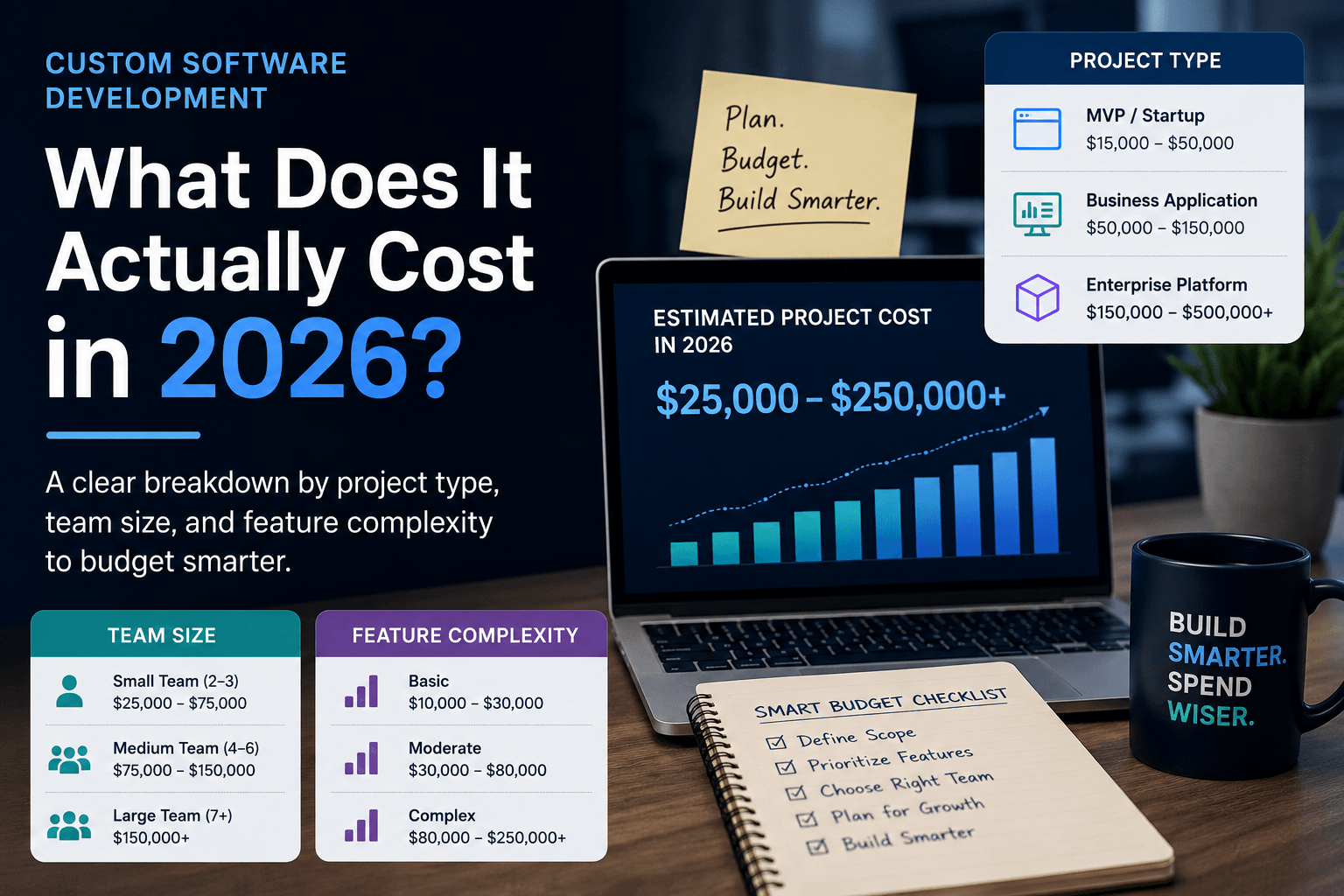
Custom software development cost per hour runs from roughly $20 to $300+. Directional market ranges: offshore about $15-$80, freelancers about $20-$150, US agencies about $100-$300. These are market ranges cited in published guides (including those from Binmile and DevSquad), not NextGen quotes. What you pay in the end depends more on hours, rework and management time than on the rate.
If you want total project ranges rather than hourly rates, start with our full custom software cost breakdown for 2026. This article focuses on the rate itself and on why it is the wrong number to optimize.
Quick-answer table: freelancer, offshore, nearshore, US studio
Vendor type | Directional hourly range | Notes |
|---|---|---|
Freelancer | about $20-$150 | Huge spread driven by seniority and market |
Offshore agency | about $15-$80 | Lowest rates, largest time zone gap |
Nearshore team | between offshore and US (varies, ask for a quote) | Overlapping working hours |
US agency or studio | about $100-$300 | Highest rates, easiest communication |
Treat every figure here as directional. A published range tells you the neighborhood, not what a specific team will charge you for a specific job.
Why the rate is only one input into what you pay
Your bill is rate multiplied by hours, plus the cost of redoing work that missed the mark, plus the time you spend managing the team. A $40 developer who needs twice the hours and two rounds of fixes can cost more than a $100 developer who gets it right the first time. Published guides from DevSquad and Binmile make a similar point: costs scale with the decisions you make and with overruns, not only with the rate card.
The rest of this article shows how to compare vendors on cost per shipped feature instead.
Average hourly rate for a software developer in the US
There is no single US average, because the answer depends on whether you mean an employee, a freelancer or an agency. For agency work, the directional market band is about $100-$300 per hour. Freelancers in the US usually sit inside the wider $20-$150 freelancer range, with experienced specialists toward the top.
Employee salary vs agency billing rate
A common mistake is dividing a developer's salary by 2,080 working hours and calling that the market rate. An employee's real cost to the company is higher than salary: benefits, payroll taxes, equipment and software, recruiting, management time and paid time off all add to it. And an employee is only productive on your roadmap for part of the paid year.
An agency rate bundles those costs and more. It is a price for delivered capacity, not a wage.
What the agency rate includes (PM, QA, overhead, bench)
When you compare an agency rate to a freelancer rate, ask what is inside it. A typical agency rate covers:
The developer's loaded cost (salary, benefits, tools)
Project management and coordination
QA and testing, in some cases
Office, legal, accounting and security overhead
Bench time, meaning the weeks when staff are between projects but still paid
Margin that keeps the studio alive for your maintenance needs next year
A low rate that excludes PM and QA is not a lower price. It moves those costs onto you.
Hourly rates by region
Region is the biggest driver of the rate, and the most misunderstood. Wide published spreads exist (some surveys show UK rates spanning something like $90 to $590) because they mix junior contractors, senior specialists and big-brand consultancies in one bucket. The table below uses only the broad bands from published market surveys, so treat it as a starting point.
Region | Directional range | How to read it |
|---|---|---|
United States and Canada | about $100-$300 for agencies | Specialists and large brands go higher |
United Kingdom | very wide in published surveys | Rate depends on seniority and firm type, ask for a quote |
Nearshore (Latin America) | varies, generally between offshore and US | Ask for a quote |
Eastern Europe | varies, often mid-band | Ask for a quote |
India and South Asia | inside the offshore band of about $15-$80 | Spread from freelancers to established firms |
United States and Canada
You pay the most and get the easiest collaboration: shared time zones, native English, and contracts enforceable in a jurisdiction you know. For products where requirements change weekly, that speed of conversation is worth real money.
Nearshore (Latin America)
Nearshore means teams in nearby time zones, which for US companies usually means Latin America. Rates tend to sit between offshore and US rates. The main benefit is overlapping working hours, so you can run a daily standup and fix problems the same day.
Eastern Europe
Eastern Europe has a deep engineering talent pool and rates that usually sit below US levels. Time zone overlap with the US is partial, so expect to schedule around a few shared hours each day.
South and Southeast Asia
This is where the lowest rates in the offshore band live. It can work very well for well-specified, self-contained work. It is harder when requirements are still forming, because every question costs you a day.
Time zone, communication and IP considerations
Offshore versus nearshore versus onshore is mostly a trade between rate and friction. Before choosing, check:
Overlap hours: how many hours per day can you talk live?
English fluency: can the people writing code also discuss trade-offs with you?
Contract enforceability: where would a dispute over IP or delivery be settled?
Turnover: if a developer leaves, who knows your codebase?
Security and compliance: especially for healthcare and finance products
Hourly rates by role and seniority
Rates rise with seniority, and the gap between junior and senior is usually wider than the gap between regions for the same level. Using the common definitions from Mad Devs, the levels look like this.
Junior, mid-level, senior (typical years of experience)
Level | Typical experience | What they do well |
|---|---|---|
Junior | 0-2 years | Well-defined tasks under review |
Mid-level | 2-5 years | Features end to end with moderate guidance |
Senior | 5+ years | Architecture, trade-offs, mentoring, unblocking others |
A senior costs more per hour than a junior. But a senior often finishes in fewer hours, produces less rework, and avoids architecture mistakes that cost far more to fix later. Junior time is cheap only when someone senior is reviewing it, and that review time has to be paid for too.
PM, QA, designer, DevOps, business analyst
Role rates generally follow seniority and scarcity. I will not quote numbers I cannot source, but the pattern is consistent:
Project manager: often priced below a senior developer, but essential once more than two or three people are involved
QA engineer: usually priced below senior developers, and the cheapest insurance on the list
Designer (UI/UX): priced like a mid or senior developer, and worth it before building, not after
DevOps engineer: often priced at or above a senior developer because of scarcity
Business analyst: valuable on complex integrations or regulated domains, optional on a simple MVP
For a small build you rarely need all of these as separate people. An MVP usually needs a senior developer, some design, and structured QA. Mid-size builds add a PM and dedicated testing. If you need to scale up capacity, dedicated development teams let you add roles as the work demands.
Why a senior lead on every project changes the math
At NextGen, one senior technical lead owns each engagement from discovery through launch. The trade-off is straightforward. You pay a higher blended rate for senior time, but you carry fewer layers of handoff: the person who scoped the work is the person accountable for shipping it. Layered teams spread work across junior hours, but each handoff adds meetings, misunderstandings and rework. Neither model is always better. A big product with many parallel workstreams needs layers, while a focused MVP often does not.
Freelancer vs offshore vs nearshore vs US studio: what you actually get
Each option has jobs it does well. The point is to match the model to your situation, not to find a universal winner.
Freelancers
Good freelancers are excellent value for small, well-defined tasks and for filling a specific skill gap. The risks are continuity (what happens if they get busy or disappear) and the fact that you become the project manager. For a deeper look, read how freelancers compare to a studio.
Offshore agencies
Offshore agencies offer the lowest rates and real capacity. They work best when your spec is clear and you have someone who can review their work. They struggle most when the product is still being discovered, because the feedback loop is slow.
Nearshore teams
Nearshore costs more than offshore but gives you live collaboration. It is a sensible middle path for startups that want to iterate daily without paying top-tier US rates.
US-based studios
Studios charge the highest rates, and in return you get tight communication, accountable ownership and usually fewer management hours on your side. They are strongest on ambiguous, high-stakes or integration-heavy work.
Side-by-side comparison table
Rate band | Management load on you | Continuity risk | Rework risk | Best for | |
|---|---|---|---|---|---|
Freelancer | about $20-$150 | High | High | Varies with seniority | Small tasks, skill gaps |
Offshore agency | about $15-$80 | Medium to high | Medium | Higher if spec is vague | Well-defined builds |
Nearshore team | Between offshore and US | Medium | Medium | Medium | Iterative products, daily collaboration |
US studio | about $100-$300 | Low to medium | Lower | Lower with senior ownership | Ambiguous, integration-heavy, high-stakes |
The honest answer to whether offshore developers are really cheaper once rework and management are counted: sometimes yes, sometimes no. It depends on how clear your spec is and how much of your time the project consumes.
Why blended cost per shipped feature beats the hourly rate
Hourly rate tells you what an hour costs. Cost per shipped feature tells you what you actually paid for working software. That is the number to compare across quotes.
The formula: rate x hours x (1 + rework) + your management time
Use this worksheet for every quote you receive:
Rate: the quoted hourly rate
Hours: the vendor's estimate, or your own adjusted estimate
Rework factor: the share of work that will need redoing (0.1 means 10 percent)
Your management time: hours you or your team will spend per project, multiplied by what that time is worth
Total cost: rate x hours x (1 + rework) + management cost
Cost per feature: total cost divided by the number of features shipped
The rework factor and management hours are judgment calls. Be honest about them, and ask references what they experienced.
A worked example with clearly hypothetical numbers
The numbers below are invented for illustration. They are not a case study or real client data.
Option A: low rate | Option B: higher rate | |
|---|---|---|
Hourly rate | $40 | $100 |
Estimated hours | 1,000 | 500 |
Rework factor | 50% | 10% |
Build cost | $60,000 | $55,000 |
Your management time (hours x $100) | 200 hours = $20,000 | 60 hours = $6,000 |
Total | $80,000 | $61,000 |
Cost per feature (10 features) | $8,000 | $6,100 |
Here the lower rate loses because it needs twice the hours, more fixes and more of your time. Now change the assumptions: the same cheap team, but the spec is clear and they hit 600 hours with 15% rework and 80 management hours. That works out to $27,600 + $8,000 = $35,600, which beats Option B. So cheap wins when work is well defined and the team is skilled. It loses when scope is fuzzy or the team needs a lot of steering.
Try your own numbers in our software development cost estimator, then plug the output into the worksheet above.
Hidden multipliers: discovery gaps, scope creep, handoffs, maintenance
Four things inflate hours more than the rate ever does:
Discovery gaps: skipping discovery means discovering requirements during the build, when changes are most expensive
Scope creep: each small addition is cheap, but together they can double a project
Handoffs: every time work passes between people, context leaks and rework appears
Maintenance: a commonly cited rule of thumb is that yearly maintenance costs roughly 15-20 percent of the original build cost. It varies by product, so ask any vendor what they assume
DevSquad and Binmile both note in their guides that costs scale with decisions and overruns. That matches what we see: the rate is visible, while the multipliers are not.
Hourly vs fixed-price vs dedicated team billing
How you are billed changes the vendor's incentives, which affects the final number as much as the rate. Hourly billing rewards time spent, fixed price rewards efficiency (and sometimes corner-cutting), and a dedicated team rewards staying on your roadmap. For a longer comparison, read dedicated team vs fixed-price agency.
When time and materials makes sense
Use time and materials (T&M) when scope is uncertain, when you expect to learn as you build, or when the product will keep evolving. It is the honest model for early-stage products, because the work genuinely cannot be fully specified up front.
When fixed price makes sense
Use fixed price when the scope is small, clear and unlikely to change, for example a defined integration or a landing page with a form. Expect the vendor to price in a risk buffer and to resist changes, so changes will go through formal change orders.
Hybrid: fixed discovery, then T&M or a dedicated team
A hybrid works well for most startups. Pay a fixed price for discovery and a written scope, then move to T&M or a dedicated team for the build. You get a defensible estimate without pretending uncertainty does not exist.
How to cap risk on hourly work
Weekly burn reports: hours spent against budget and what was delivered
Budget caps: a not-to-exceed amount per phase, requiring written approval to go beyond it
Milestone demos: working software every one to two weeks, not a big reveal
Written change orders: every scope change priced and approved before work starts
Phase gates: the right to stop or change direction after each milestone
These tactics also quietly answer the question of how much you should charge for your own software: the price you set has to cover the vendor costs, your support and maintenance, so be sure to include the 15-20 percent yearly rule of thumb in your model.
How to evaluate and compare quotes
Two quotes with the same total can hide very different risk. Normalize them before you decide. If you are running a formal process, here is how to write a software development RFP so every vendor quotes the same scope.
Checklist of questions to ask every vendor
Who actually writes the code, and are they employees or subcontractors?
What is the seniority mix on my project?
Is QA included, and who does it?
Do I own the code and IP from day one?
What documentation and handover do I get?
How are change requests priced?
Who is the single point of accountability for delivery?
Can I talk to a recent client about hours versus estimate?
Red flags in a low hourly rate
No discovery or written scope before pricing
QA, PM and DevOps missing from the quote
An estimate that arrives within hours, with no questions asked
Vague answers about who does the work
IP ownership that depends on final payment terms you have not read
Pressure to sign before you compare
A low rate is fine when the vendor can explain why it is low and what is excluded. It is a red flag when they cannot.
What a good estimate contains
A useful estimate breaks work into features or milestones, shows hours per piece, states assumptions, lists exclusions, and gives a range instead of one falsely precise number. It also names the team, the QA approach and the plan for handover.
What the 40/20/40 rule means for your budget
The 40/20/40 rule is a rule of thumb, not a universal standard. It says that roughly 40 percent of effort goes to planning and design, 20 percent to coding, and 40 percent to testing, integration and launch.
The rule explained
The split varies by project, so treat the proportions as a reminder rather than a formula. A prototype may spend less on testing, and a regulated healthcare product far more. The useful insight is that coding is a minority of the effort.
How to map it to discovery, build and QA/launch hours
Phase | Rule-of-thumb share | What happens |
|---|---|---|
Discovery and design | about 40% | Requirements, UX, architecture, estimates |
Build | about 20% | Writing the code |
QA, integration, launch | about 40% | Testing, fixes, integrations, deployment, handover |
If coding is only a fifth of the effort, then saving 50 percent on the coding rate saves roughly 10 percent of the total, while a mistake in planning or testing can cost much more. So pay attention to the whole process, not only the coding rate.
How much does it cost to hire an app developer per hour?
App developers generally charge in the same bands as other developers: roughly $20-$150 for freelancers, $15-$80 offshore and $100-$300 for US agencies. Specialization, seniority and region move the number far more than whether the work is mobile or web.
Mobile developer rates vs web developer rates
Mobile specialists can be somewhat scarcer than web developers, which can push rates up at the senior end. But the difference is small compared with the difference between a junior and a senior.
Native vs React Native/cross-platform effects on hours
What matters more is the total hours. Building separate native iOS and Android apps means two codebases. React Native or another cross-platform approach shares much of the code, which can reduce total hours when the product does not need heavy platform-specific features. Native still makes sense for graphics-heavy, hardware-intensive or highly platform-specific apps.
Next steps: turn a rate into a real budget
A rate is a starting point. A budget comes from scope, hours, risk and your own time. To reduce cost without cutting corners:
Build an MVP first and add features after real users react
Pay for discovery so scope is written down before coding starts
Keep scope clear and route changes through written change orders
Choose the vendor type that fits how well-defined your product is
For context on project size, rough planning bands are small builds in the hundreds of hours, mid-size builds in the low thousands, and large products well beyond that. Multiply by the rate band that fits your vendor type, then add rework and management time. Our full cost article covers totals in more depth.
Use the cost estimator
The software development cost estimator gives you a first-pass range from your feature list. Use it to sanity-check any quote you receive.
Talk to a senior lead before you sign anything
Bring two competing quotes and run the cost-per-feature worksheet on each. If the numbers look close, the deciding factors are seniority, accountability and how each vendor handles change.
If you would like a second pair of eyes on your quotes or your scope, you can book a free discovery call at https://www.nextgensoftware.us/contacts. You will talk with a senior technical lead, and you will leave with a clearer budget whether or not we end up working together.
Frequently Asked Questions
What is the average hourly rate for custom software development?
Market ranges run from roughly $20 to $300+ per hour. Directionally, offshore is about $15-$80, freelancers about $20-$150 and US agencies about $100-$300. These are published market ranges, not quotes from any one vendor.
Are offshore developers really cheaper once rework and management are counted?
Sometimes. Offshore works well for clearly specified work with a client who can review output, and it loses ground when requirements are vague or the team needs constant steering. Run the cost-per-feature worksheet with honest rework and management-hour assumptions to see where you land.
Is hourly or fixed-price better for custom software?
Fixed price suits small, clear scopes that are unlikely to change. Hourly or a dedicated team suits products where scope will evolve. Many founders pay a fixed price for discovery and then move to hourly or a dedicated team for the build.
What is the 40/20/40 rule in software development?
It is a rule of thumb that about 40 percent of effort goes to planning and design, 20 percent to coding, and 40 percent to testing, integration and launch. It is not a universal standard and varies by project. The takeaway is that coding is a minority of the work, so the coding rate is only part of your cost.
How can I cap the cost of an hourly engagement?
Ask for weekly burn reports, set a not-to-exceed budget per phase, and require milestone demos every one to two weeks. Price every scope change through a written change order before work begins. These habits keep you in control without needing a fixed price.