Full Cycle Software Development: Phases, Ownership, Fit

What is full-cycle software development? (the short answer)
Full cycle software development is an engagement model where one team owns a product from discovery and design through build, testing, launch and ongoing support, with a single point of accountability. You do not manage a separate vendor for each stage. One group is responsible for the outcome, not just a slice of the work.
It is not a methodology, not a pricing model, and not just coding. A full-cycle partner can work on a fixed scope or on time and materials, and can run Agile sprints inside the engagement. The label describes who is accountable, not how the work is billed. NextGen's full-cycle product development service follows this model.
In this guide: how full-cycle differs from the SDLC and Agile, who owns what in each phase, how it compares with piecemeal outsourcing, when it is and is not the right call, what to ask before signing, and what drives cost.
Full-cycle vs the SDLC vs Agile: clearing up the terms
These three terms get mixed up constantly, and they answer three different questions. The SDLC asks what stages does software go through? Full-cycle asks who is responsible for all of them? Agile asks how is the work organized inside those stages?
SDLC is the map, full-cycle is who walks it
The software development life cycle (SDLC) is the set of phases any software passes through: planning and requirements, design, development, testing, deployment and maintenance. Every project has an SDLC whether anyone writes it down or not. Some teams skip phases, and that is usually where trouble starts.
You will see SDLC lists with 6, 7 or 8 steps. The extra steps are usually just a split of planning from requirements analysis, or an added documentation step. The underlying journey is the same.
Full-cycle is an engagement model: one partner covers the whole map. You could follow the SDLC perfectly and still split it across five vendors. That would not be full-cycle.
Where Agile fits
Agile is not a replacement for the SDLC. It is a way of working through the phases in short, repeated loops instead of one long sequence. You still plan, design, build, test and release, but you do it in small increments and adjust based on what you learn.
Most full-cycle teams use Agile and iterative delivery, because shipping an MVP and learning from real users beats guessing everything up front. Agile describes the rhythm. Full-cycle describes the ownership.
The 40/20/40 rule, briefly
The 40/20/40 rule is a heuristic, not a measured standard. It says roughly 40% of effort goes to up-front analysis and design, 20% to coding, and 40% to testing and integration. Treat the exact numbers loosely.
The useful point is that coding is the smallest slice. If you hire only for the 20%, someone still has to own the other 80%, and that is the work that tends to go unowned in piecemeal setups.
The phases of a full-cycle engagement, and who owns what
Below is the typical flow, with what the client provides and what the partner owns. Details shift by project, but the pattern holds.
1. Discovery and scoping
This is where planning and requirements happen. The partner interviews you, maps users and workflows, flags risks (unclear scope, wrong technology choices, integration unknowns) and decides what the MVP actually includes.
You provide: business goals, user knowledge, existing tools and data, decision-making access.
Partner owns: requirements, scope boundaries, technical approach, risk list.
Output: a scoped plan, prioritized feature list and rough architecture.
Skipping this phase is the most common source of expensive rework later.
2. UX/UI design and prototyping
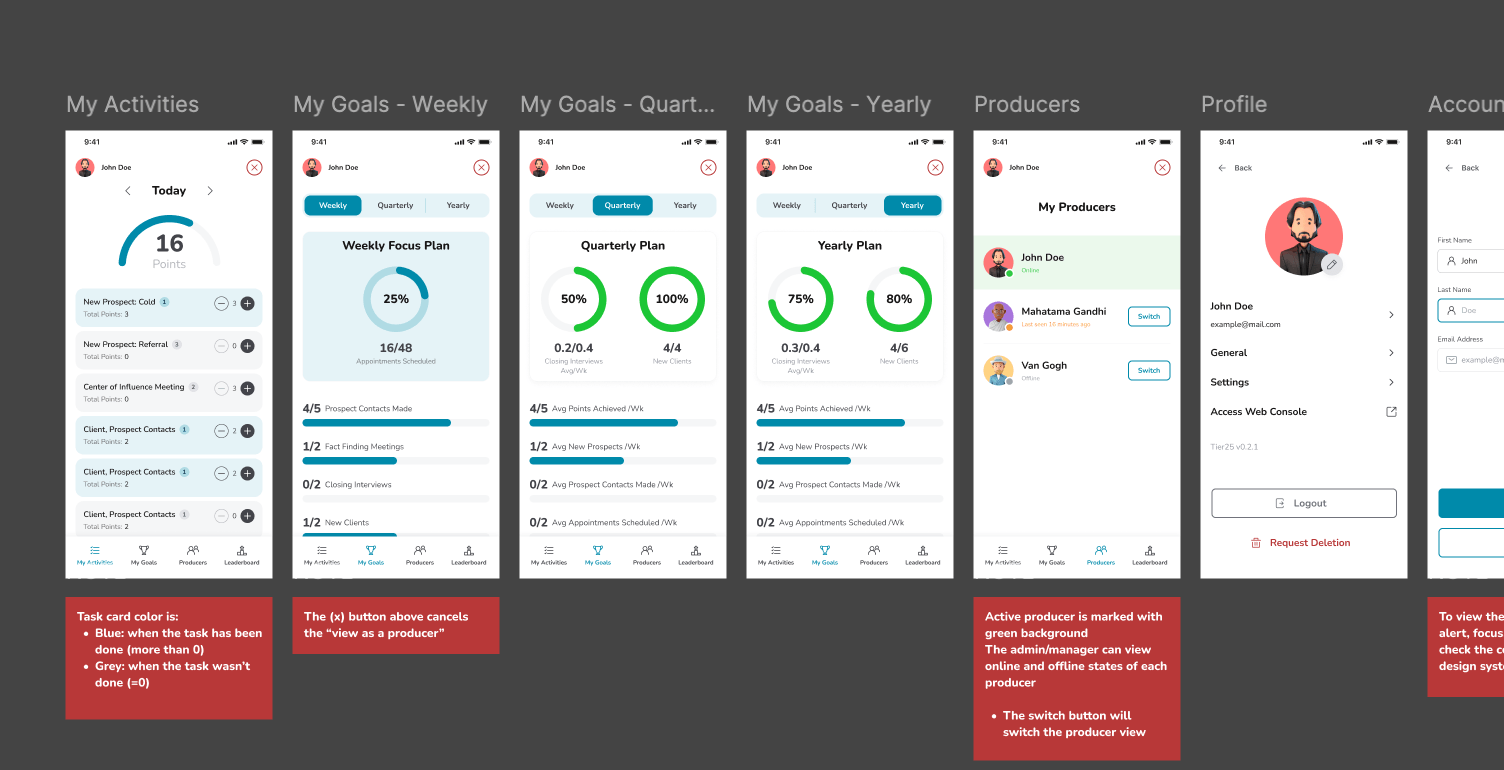
Design turns requirements into flows and screens, then into a clickable prototype you can test with real users before anyone writes production code. In a full-cycle model, designers work with engineers, so the design does not promise things the stack cannot deliver cheaply.
You provide: feedback, brand assets, access to a few real users if possible.
Partner owns: user flows, wireframes, UI design, prototype.
Output: approved designs and a prototype that engineering builds from.
3. Architecture and build
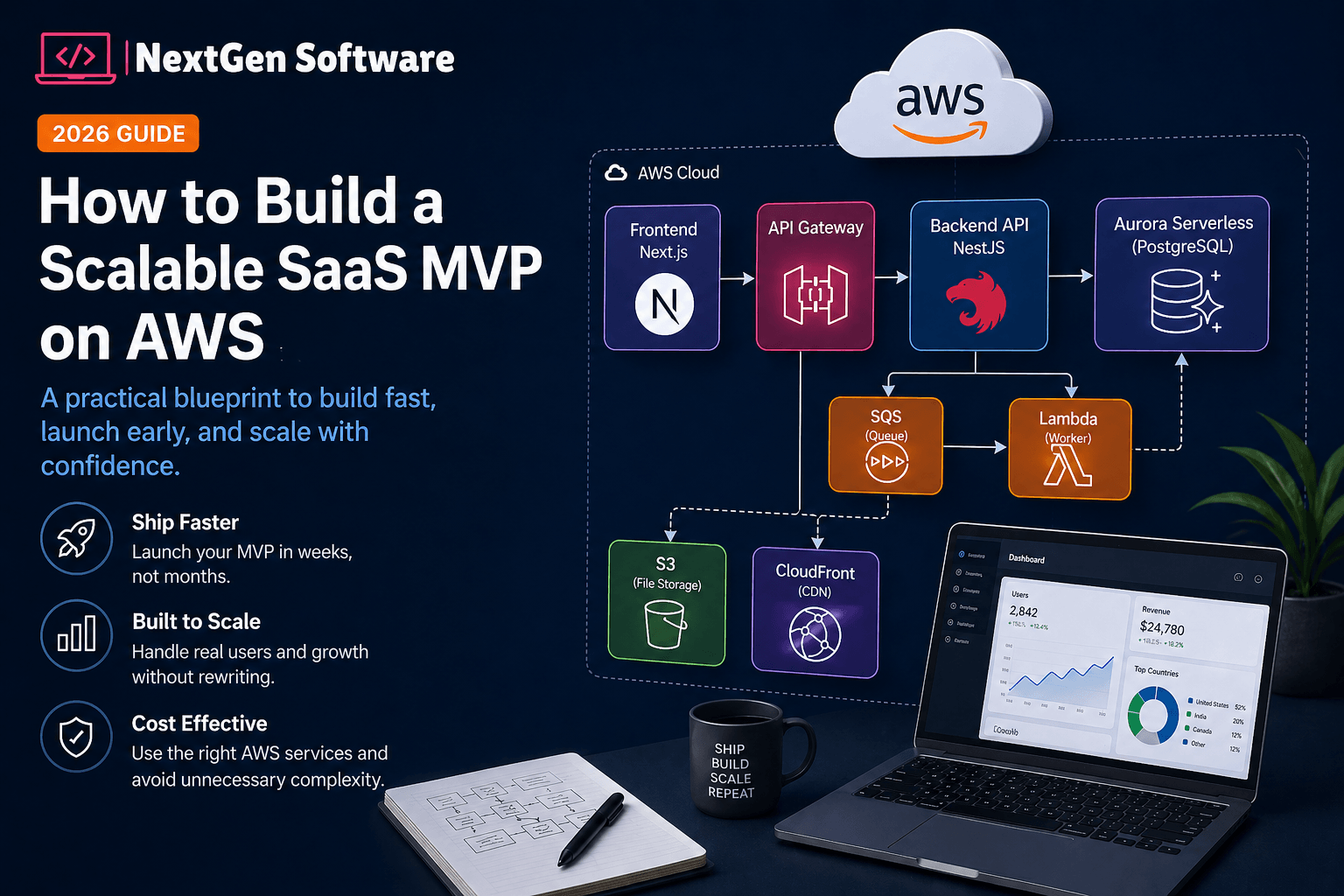
This is the part most people picture as software development. The team chooses the architecture and builds the product. For a SaaS product that typically means authentication, billing, dashboards and the core workflow, plus integrations such as Stripe, Shopify, NetSuite or HubSpot.
You provide: timely answers, access to third-party accounts and APIs.
Partner owns: architecture, code quality, integration design, regular working demos.
Output: working software in a staging environment, reviewed in short cycles.
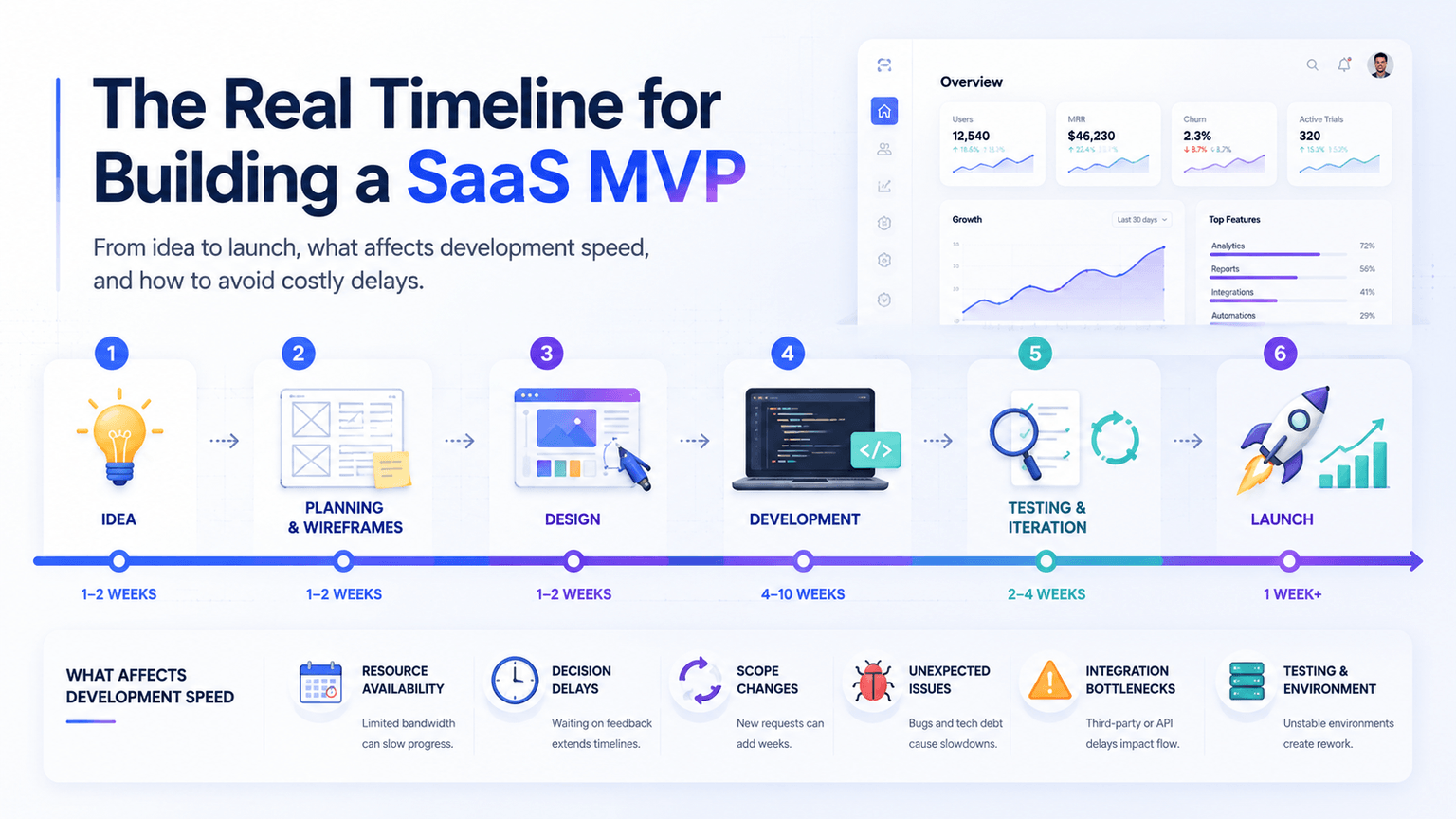
For a sense of pace on a first release, see how long a SaaS MVP takes.
4. Testing and QA
Testing covers functional checks, edge cases, integrations, performance and security basics. In a handoff-heavy setup this is often the phase nobody owns. In full-cycle, the same team that built the feature is accountable for it working.
You provide: acceptance criteria and user acceptance testing.
Partner owns: test plan, automated and manual testing, bug triage and fixes.
Output: a release candidate with known issues documented.
5. Launch and deployment
Deployment means production infrastructure, environment configuration, data migration if needed, monitoring and a rollback plan. Launch day should be boring because the team rehearsed it.
You provide: go-live decision, domain and account access, any launch communications.
Partner owns: deployment, infrastructure setup, monitoring, launch checklist.
Output: the product live, with alerts and documentation.
6. Support, iteration and scaling
Maintenance is not an afterthought. Real users surface issues and ideas the team could not predict. A full-cycle partner stays accountable for uptime, fixes, security updates and the next round of features.
You provide: product priorities and user feedback.
Partner owns: bug fixes, updates, monitoring, performance and the roadmap's technical side.
Output: a product that keeps working and improving.
Full-cycle vs piecemeal outsourcing
What piecemeal looks like (design agency + freelancers + separate DevOps)
Piecemeal outsourcing means you hire a design agency for the UI, a few freelancers for the code, someone else for infrastructure, and maybe a separate QA contractor. Each is good at one thing. You become the project manager and the integrator, whether you planned to or not.
This can work well if you have an in-house technical lead who can direct the pieces. It is a harder path for a non-technical founder. For a closer look at one version of this choice, read about hiring freelancers vs a studio.
Where handoffs break things
Every handoff loses information. These are the failure modes we see most:
Design ignores technical constraints. A beautiful design needs a custom component that triples build effort, and nobody flagged it.
Requirements get lost between discovery and build. The people who heard the reasoning are not the people writing the code.
No one owns QA. Developers assume the QA contractor will catch it, and the contractor tests only what was documented.
No one owns production after launch. The freelancers move on, and the app goes down on a Saturday with nobody responsible.
Finger-pointing. When something breaks across the seams, each vendor says it is another vendor's problem.
These are qualitative risks, not guarantees. A well-run piecemeal project can avoid them, but it takes real coordination effort from you.
Side-by-side comparison
Factor | Full-cycle partner | Piecemeal vendors | Dedicated team |
|---|---|---|---|
Accountability | One team for the outcome | Split, often unclear | You direct, team executes |
Communication overhead | Low for you | High, you coordinate | Moderate, you manage priorities |
Speed to first release | Strong, fewer handoffs | Depends on your coordination | Fast if you have clear specs |
Flexibility | Good, within the partner's skills | High, swap pieces freely | High, scale people up and down |
Cost visibility | Clear if scoped well | Fragmented across invoices | Predictable monthly, scope varies |
Vendor dependence | Higher on one partner | Spread across several | Moderate |
Best for | Non-technical founders, new products | Teams with a strong technical lead | Teams with product and engineering leadership |
Piecemeal can be cheaper per hour, and it gives control to teams that can use it. Full-cycle trades some of that control for accountability and less coordination work.
When full-cycle is worth it (and when it isn't)
Good fit signals
You are a non-technical founder or operator without an in-house CTO.
You are building an MVP or a new product and need decisions made across design, engineering and infrastructure.
You want one accountable owner instead of managing several vendors.
The project needs several disciplines at once: UX, backend, integrations, DevOps.
You expect to keep evolving the product after launch.
Poor fit signals
You already have a strong engineering team and only need more capacity. A dedicated team usually fits better.
The job is a tiny one-off fix or a small script, where a full engagement is overkill.
The project is fully specified, stable and well understood, and you can manage it yourself.
You want to keep all technical decisions in-house and treat the vendor as extra hands.
Alternatives: dedicated team or in-house hires
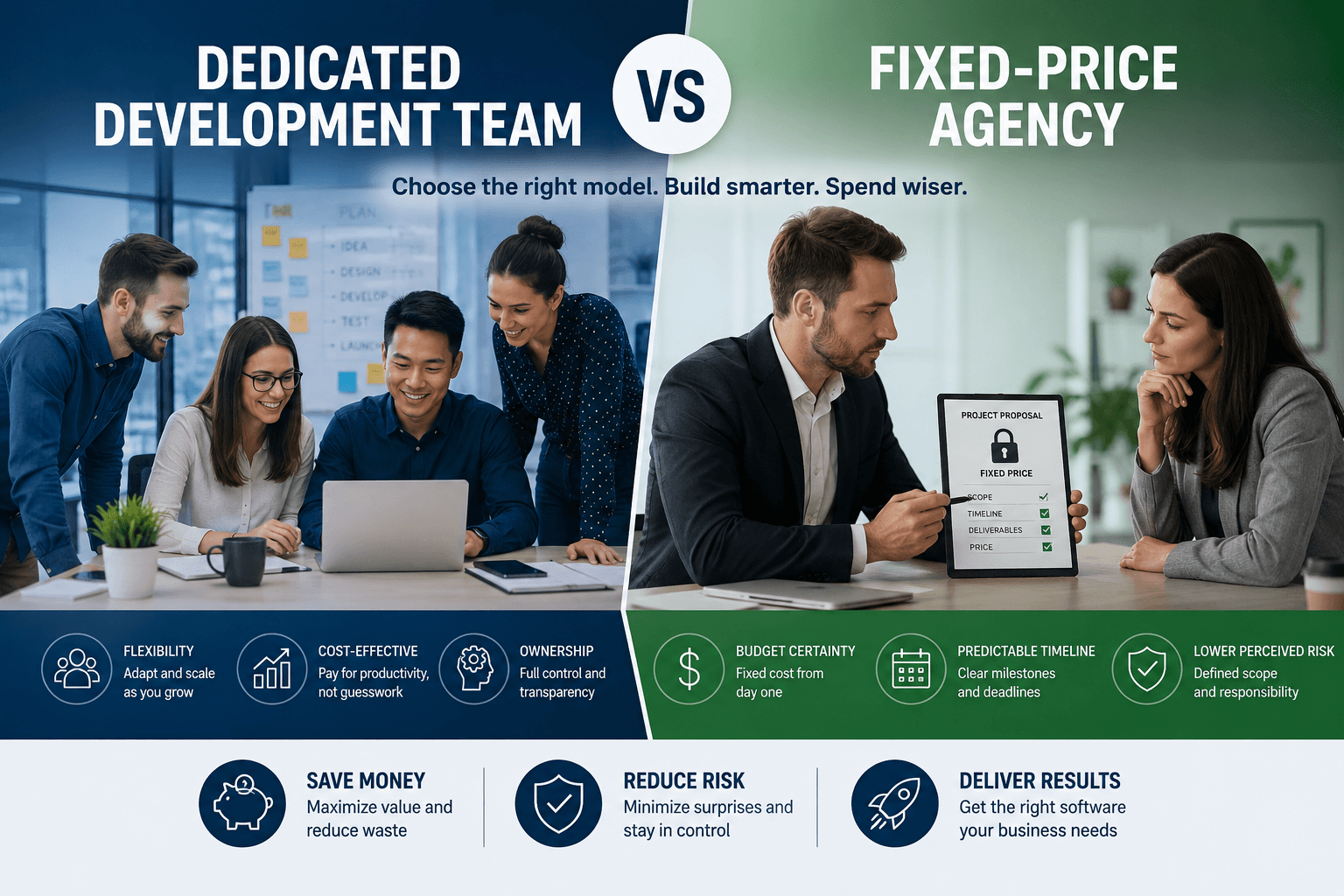
A dedicated team gives you developers who work as an extension of your own, while you keep product direction. Full-cycle gives you a partner who shares ownership of that direction. The trade-offs between those models, and fixed-price work, are covered in dedicated team vs fixed-price agency.
In-house hires make sense when software is your core, long-term competency and you can recruit and retain senior people. Many companies start full-cycle, then bring engineering in-house once the product proves itself.
What to ask a full-cycle partner before you sign
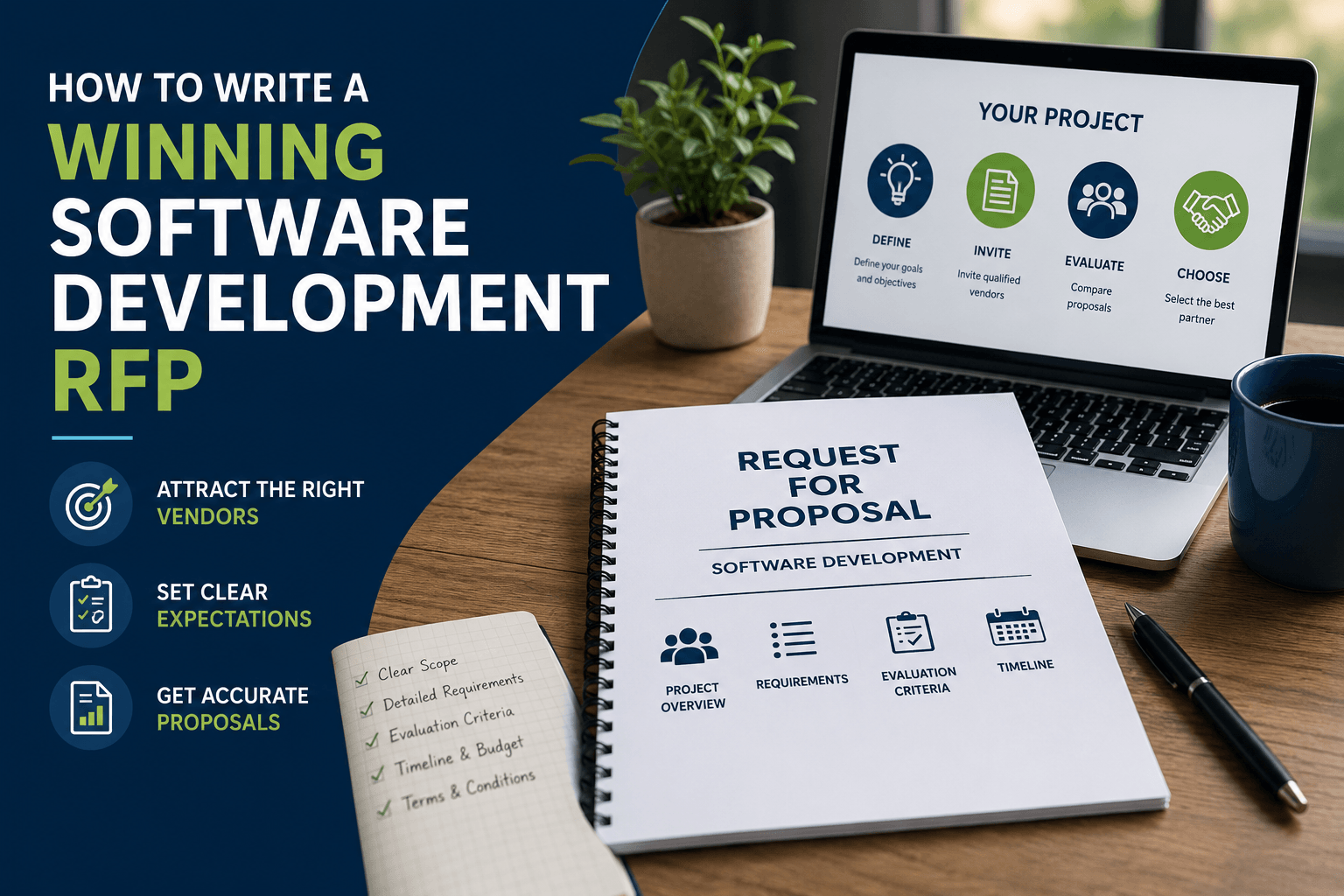
If you are also writing an RFP, the same questions apply there. Use these as a vetting checklist.
Who is my single point of contact and are they senior?
A single point of accountability is only useful if that person can make technical decisions. Ask who they are, how much of their time your project gets, and whether they will still be involved after the sales conversation. At NextGen, one senior technical lead owns each engagement from discovery through launch.
Who owns the code, infrastructure and accounts?
You should own the code, the repositories, the cloud accounts, the domains and the third-party accounts. Ask for this in writing. Confirm you will have admin access during the project, not just at the end, and that documentation is part of the deliverable.
How do you handle scope changes?
Scope will change. Ask how changes are estimated, approved and tracked, and what happens to the timeline. A clear change process protects both sides. Also ask what testing is expected: automated tests, QA passes and acceptance criteria.
What happens after launch?
Get specifics on support terms: who responds to incidents, how bugs are handled, what monitoring exists, and how ongoing development is priced. Vague promises of support are a warning sign.
Can you rescue or take over an existing codebase?
If you already have a stalled or messy product, a full-cycle partner should be able to audit it, tell you honestly whether to fix or rebuild, and take ownership. Our software project rescue playbook walks through how that works.
How cost and timeline behave in a full-cycle project
What drives cost
I will not quote a single number here, because honest numbers depend on your scope. These are the drivers that move the price most:
Scope: the number and complexity of features and user roles.
Integrations: payment, ERP, CRM, ecommerce and AI services each add design and testing work.
Platforms: web only, or also iOS and Android.
Design depth: a clean standard interface versus heavy custom design and prototyping.
Compliance: healthcare, finance and similar fields add security and audit work.
Team seniority: senior people cost more per hour and often cost less per outcome.
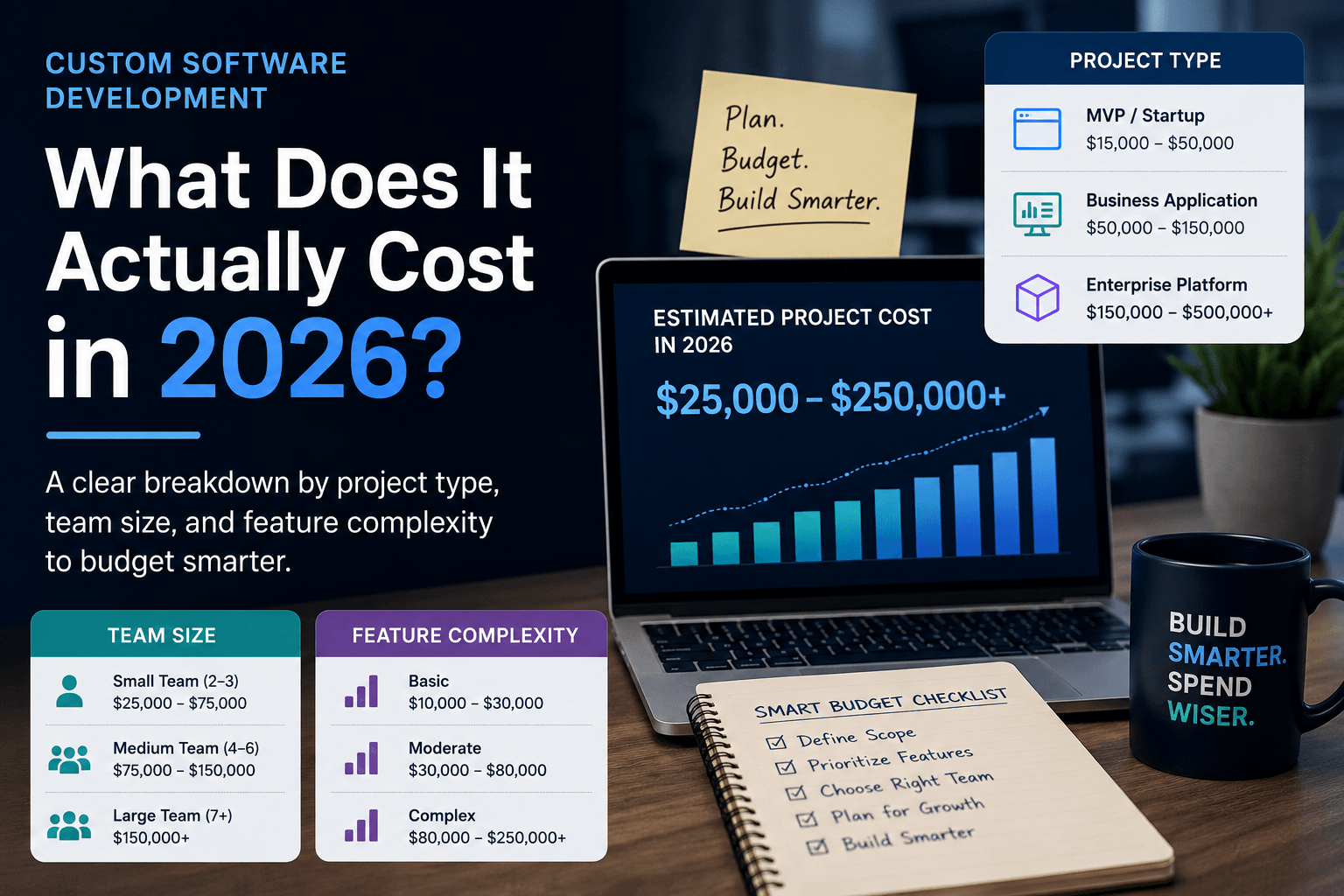
For ranges and examples, see the custom software development cost breakdown.
Why up-front discovery saves money
The expensive mistakes in software are unclear scope and the wrong technology choice. Both are cheap to fix on paper and costly to fix in code. Discovery is where you find the integration that does not work the way you assumed, or the feature nobody needs. Paying for it first usually costs less than discovering the same issues in month three.
Getting a ballpark
Start with a rough feature list and your main integrations. Use the cost estimator tool for a first range, read the MVP timeline article for pacing, and then book a scoping conversation to turn the range into a plan. Treat any quote given without discovery as a guess.
Bottom line and next step
Full cycle software development puts one accountable team across discovery, design, build, testing, launch and support. It is an ownership model, separate from the SDLC (the phases) and Agile (the working rhythm). It fits best when you lack an in-house technical lead, are building a new product, or want to stop being the integrator between vendors. It fits poorly when you only need extra hands or the job is small and well defined.
If you want to see how it would apply to your product, read more about our full-cycle product development approach. Or, if you would rather talk it through, book a free discovery call at https://www.nextgensoftware.us/contacts. Bring your idea or your stalled project, and you will leave with a clearer view of scope, risks and next steps, whether or not we end up working together.
Frequently Asked Questions
What is full-cycle software development?
It is an engagement model where one team owns a product from discovery and design through build, testing, launch and ongoing support. You get a single point of accountability instead of coordinating several vendors. It describes who is responsible, not a specific methodology or price model.
Is the SDLC different from Agile?
Yes. The SDLC lists the phases software passes through, such as planning, design, development, testing, deployment and maintenance. Agile is a way of working through those phases in short, iterative cycles. Most teams use both together.
What is the 40/20/40 rule in software engineering?
It is a rule of thumb that roughly 40% of effort goes to analysis and design, 20% to coding, and 40% to testing and integration. It is a heuristic, not a measured standard. Its main lesson is that coding is the smallest slice of the work.
How is full-cycle different from a dedicated development team?
With a dedicated team, you direct the work and the developers act as an extension of your staff. With full-cycle, the partner shares accountability for the outcome, including design, QA, launch and support. Dedicated teams suit companies with strong product and engineering leadership, while full-cycle suits those without it.
Can a full-cycle team take over an existing product?
Often yes. A good partner will audit the codebase first, then tell you honestly whether to fix, refactor or rebuild. After that, they take ownership of testing, deployment and support.